Can I Exchange a Rental Property for Vacant Land or Commercial Property with a 1031 Tax-Deferred Exchange?
- Darlene Jones

- Mar 17
- 2 min read
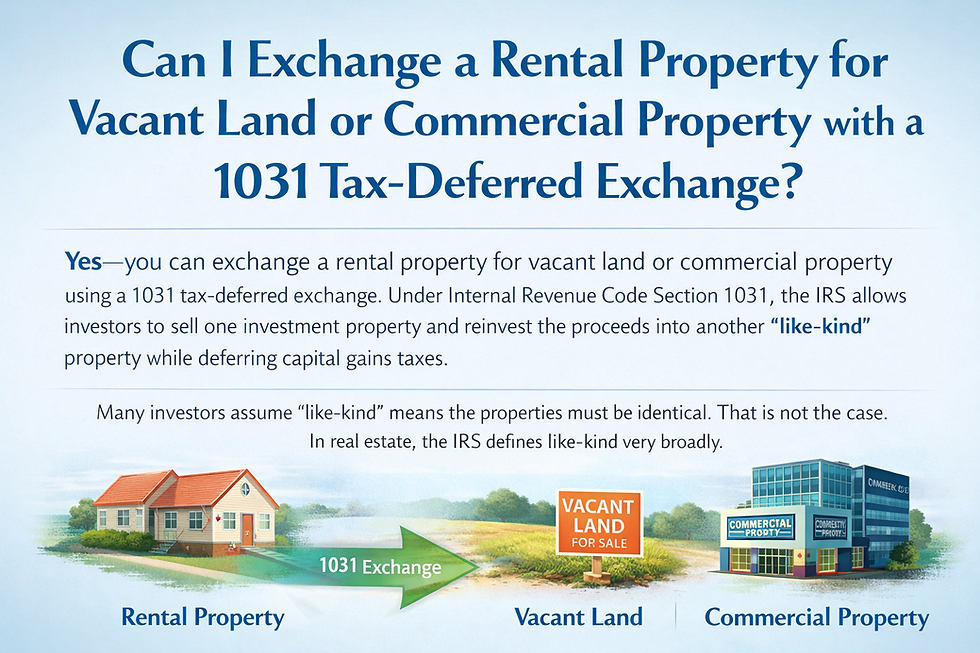
What "Like-Kind" Really Means
Under Internal Revenue Code Section 1031, almost all real estate held for
investment or business purposes qualifies as like-kind to other investment real
estate.
That means you can exchange:
A single-family rental for vacant land
A duplex or apartment building for a commercial office building
A rental home for retail property
Agricultural land for income-producing commercial property
The key requirement is investment intent. Both the property you sell and the property you purchase must be held for investment or used in a trade or business.
For example, if you sell a rental property in another state and want to reposition your investment into Florida land for future development—or a commercial building generating income—that generally qualifies as a like-kind exchange.
Exchanging a Rental Property for Vacant Land

Exchanging a Rental Property for Commercial Property

Important 1031 Exchange Rules
While a 1031 exchange is powerful, the IRS requires strict compliance with several
rules. Under Internal Revenue Code Section 1031, investors must follow these timelines:
45-Day Identification Period
After selling your property, you have 45 days to identify potential replacement properties.
180-Day Closing Period
You must complete the purchase of the replacement property within 180 days.
Use of a Qualified Intermediary
You cannot receive the sale proceeds directly. Funds must be held by a qualified
intermediary (QI) until the new property is purchased.
Equal or Greater Value Rule
To defer all taxes, the replacement property should be equal to or greater than the
value of the property you sold, and all equity must be reinvested.
What Properties Do NOT Qualify?
Although 1031 exchanges allow flexibility, certain types of property are excluded.
These include: • Primary residences
• Vacation homes used primarily for personal use
• Fix-and-flip properties held for resale
• Stocks or partnership interests
Only investment or business-use real estate qualifies.
Why Many Investors Use 1031 Exchanges When Relocating to Florida
Investors across the country are increasingly using 1031 exchanges to move equity
into Florida real estate.
Florida offers several advantages:
• No state income tax
• Strong population growth
• Booming housing demand
• Expanding commercial markets
• Year-round lifestyle appeal
Many investors choose to sell high-maintenance properties in northern states and
redeploy that capital into Florida investment property, often improving both cash
flow and lifestyle.
Thinking About a 1031 Exchange?
A properly structured exchange can help you:
✔ Defer capital gains taxes
✔ Reposition your investment portfolio
✔ Increase income potential
✔ Move investment capital into stronger markets
However, timing and planning are critical. The 45-day identification window comes quickly, and having a strategy in place before selling your property is essential.
Get Your Free 1031 Relocation Strategy Consultation
If you’re considering selling an investment property and want to explore 1031 exchange opportunities in Florida, I’m happy to help.
I work with investors who want to:
• Relocate equity into Florida real estate
• Exchange rental properties into land or commercial investments
• Identify strong investment opportunities in the New Port Richey and Gulf Coast
market
Reach out today for a free strategy conversation. Let’s discuss how you can move your equity, defer taxes, and position your real estate investments for the future.


Comments